
PMP Certification Training Course
The most comprehensive PMP® Certification Training Course for Guaranteed Exam Success


Succeed with upGrad
- Ace your PMP® exam in the very first go with a learning path that ensures success
- Prepare to clear your exam with utmost confidence with our assured, tried, and tested program
- Training aligned to the latest PMP Certification Exam Content Outline

400,000 +
Professionals trained

250 +
Workshops every month

100 +
Countries and counting
PMP Certification Training Course
Experience the difference of expert PMP coaching and maximize your chances of success.
- Achieve your PMP certification in the first attempt and unlock new career opportunities with confidence at our premier training centre.
- Expert instructors, comprehensive materials, and personalized coaching dedicated to your success.
- Elevate your skills and become a sought-after project management professional with our updated and relevant PMP training courses.
PMP Training Highlights

- Benefit from 35 contact hours of instruction in a dynamic and engaging learning environment
- Benefit from expert guidance by experienced instructors for a guaranteed pass.
- Experience hands-on learning with a vast question bank of over 2800 questions.
- Test your knowledge with multiple attempts on 8 mock tests.
- Prepare effectively with 8 full-length exam simulations.
- Access refresher courses with a 180-day Grand Pass.
- Attend frequent doubt clarification sessions to enhance understanding.
- Receive comprehensive assistance with your PMP exam application.
- Gain intensive support and valuable tips for exam strategies.
The upGradAdvantage - Why upGrad
How to get PMP Certification?
Getting PMP certification involves several important steps that need to be followed in a sequential manner. Here are the steps on how to get your PMP certification:
Meet the eligibility criteria: For being eligible for the PMP certification, you need to have a secondary degree (high school diploma, associate’s degree or equivalent) with a minimum of five years of project management experience or a four-year degree with at least three years of experience in project management. You also need to have completed 35 hours of project management education.
Submit your application: Once you meet the eligibility criteria, you need to submit your application for the PMP certification exam. You can do this online on the PMI (Project Management Institute) website. You will need to provide details about your education, work experience, and project management education.
Application review: PMI will be reviewing your application. They will verify your work experience and education, and will inform you if you are eligible to take the exam. If there are any discrepancies, they will inform you and request more information.
Pay the exam fee: Once your application is accepted, you will need to pay the exam fee. The fee is $405 for PMI members and $555 for non-members.
Schedule the exam: After paying the exam fee, you can schedule your exam. You can do this online on the PMI website. You can choose a date and time that is convenient for you.
Prepare for the exam: You will need to prepare for the exam by studying the PMBOK (Project Management Body of Knowledge) guide and other study materials. There are several online courses and study materials available to help you prepare.
Take the exam: On the day of the exam, you will need to bring a valid ID and arrive at the testing center on time. The exam consists of 200 multiple-choice questions and you have four hours to complete it.
Receive your results: After completing the exam, you will receive your results immediately. If you pass, you will receive your PMP certification within a few weeks. If you do not pass, you can retake the exam.
Maintain your Certification: The validity of your PMP certification is 3 years and therefore to maintain your PMP certification, you will need to invest 60 hours in professional development activities.
PMP Success Roadmap
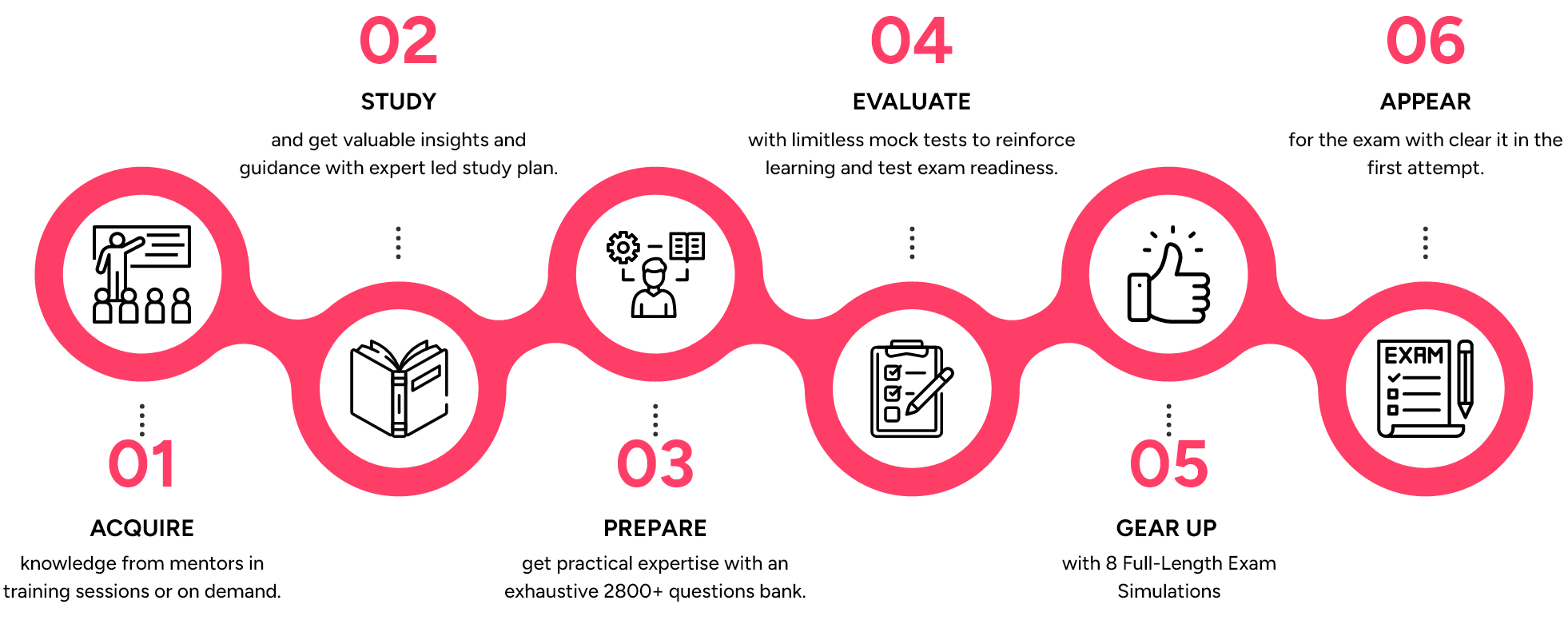
The PMP certification process can be overwhelming. Our PMP Success roadmap is designed to ease the process and advance your career. With training oriented towards solving problems, we ensure you are confident in your path to PMP certification.
Here’s how we do it:
Who Should Attend the PMP Course Online?
- Mid-Level, Senior Project Managers
- Project Leaders
- Project Sponsors
- Project Coordinators
- Product Managers
- Team Leaders
- Project Analysts
- Program Managers
- Professionals interested in building project management skills
About PMP Exam
PMP is a close book exam. You cannot refer to any study material during your examination. The PMP exam is computer-based and is administered at designated testing centers worldwide. After completing the exam, you will receive a pass/fail result on the computer screen.
To crack the PMP exam, you need to answer questions under 3 domains:
People (42%): Focuses on the soft skills needed for leading high-functioning teams.
Process (50%): Focuses on the technical aspects for driving successful projects.
Business Environment (8%): Focuses on aligning projects with organizational strategies and goals.
The PMP certification exam is a computer-based test that lasts for four hours. You have 230 minutes to complete the exam, which consists of 180 multiple-choice questions. If you are writing the exam online, you get to take two 10-minute breaks. There is no break if you attend the exam physically.
It is important to note that the PMP exam is challenging and requires a significant amount of preparation. PMI recommends that candidates spend at least 35 hours preparing for the exam.
Prerequisites for PMP certification training
- There are no prerequisites to attend the PMP certification training.
- There are very specific eligibility requirements concerning educational background (diploma, degree, master's or global equivalent), project management experience and project management education to qualify for the PMP exam. More information in FAQs.
Skills You'll Gain with the PMP Training Online

- Leadership
- Team building
- Negotiation
- Problem-solving
- Operations management
- Budget planning
- Time management
- Conflict resolution
- Agility
- Leading change
- Project communications
- Project governance
- Mentorship
- Motivation
- Risk management
- Customer service
- Project risk assessment
Build High-Performance Project Management Teams
Whether you want to grow your company or compete more effectively, project management is a must-have skill. Improve the productivity and effectiveness of your project teams and your entire organization.
- Train your project teams on best practices across industries.
- Align skill development with your business objectives.
- Leverage upGrad Immersive Learning approach.
- Get in touch for customized PMP corporate training programs.





PMP Certification Course Syllabus
Speak to Our Learning Counselor
By tapping Get a Call Back, you agree to upGrad Privacy Policy and Terms & Conditions.
Frequently Asked Questions
- PMP Certification
PMP stands for Project Management Professional certification, which is a globally recognized professional certification for project managers. The PMP certification is awarded by the Project Management Institute (PMI) and signifies that an
individual has demonstrated knowledge and expertise in project management.
- Improved job prospects
- Increased earning potential
- Enhanced credibility
- Improved project management skills
- Expanded network of project management professionals
- Helps you earn PDUs that help fulfill Continuous Credential Requirements or CCRs.
- Meet the eligibility requirements
- Submit your application at the official PMI website
- Undergo training
- Prepare for the exam
- Pass the exam
- Gain Certification
Educational Qualification
Bachelor’s or equivalent from an accredited university or college.
Project Management Experience
Minimum 4500 hours of project management experience leading and directing projects.
Project Management Training
Completed 35 hours of formal project management education. This education must be completed before you submit your PMP application.
Once you meet these prerequisites, you can enroll in PMP certification training to prepare for the PMP exam.
–
- Determine your eligibility
- Complete an online application
- Undertake 35 hours of training
- Apply to take the exam
- Prepare for the exam with study plan and material
- Pass the exam to get certified.
Once you pass the PMP exam, it typically takes 5 business days for PMI to process and finalize your certification. You will receive an email notification once your certification has been approved and you can log in to the PMI website to view and download your certificate.
You can renew your PMP certification by following these 3 simple steps:
Step 1: Earn 60 PDUs every 3 years
Step 2: Enter PDUs in the CCR system
Step 3: Make the renewal payment
- PMP Training
At upGrad, we are a leading centre dedicated to re-energizing your career and creating new opportunities for professional growth with our state-of-the-art PMP Training courses.
Our industry-led course is designed to serve students and working professionals by providing them with appropriate resources required for PMP Certification. Our curriculum includes lectures, case studies, and hands-on exercises in accordance with the Project Management Institute (PMI).
PMP training is essential for project managers who want to develop their skills, knowledge, and expertise in project management. The PMP certification is globally recognized and respected, and it demonstrates that an individual has the knowledge and experience to manage projects effectively.
There are many training providers that offer PMP certification training courses. You can search for training providers online, and many of them offer both online and in-person training options. It’s important to do your research and choose a training provider that is reputable, offers high-quality training programs and is an Authorized Training Partner of PMI just like upGrad.
Overall, completing the PMP course and earning the PMP certification can provide a range of benefits, including improved project management skills, enhanced job prospects, networking opportunities, and ongoing professional development.
- PMP Exam Preparation
Preparing for the PMP exam requires a combination of studying, practicing, and applying the knowledge you’ve learned.
- Understand the exam format
- Study the PMBOK Guide
- Take a PMP Exam Prep Course
- Practice with PMP Exam Simulators
- Create a Study Plan
- Take mock tests.
Preparing for the PMP exam requires dedication, commitment, and hard work.
The actual amount of study time required may vary based on your individual circumstances and study habits.
The amount of time required to study for the PMP exam varies depending on several factors, including your existing knowledge of project management, your study habits, and your availability to study.
The Project Management Body of Knowledge (PMBOK) Guide is the primary source of information for the PMP exam, and it is recommended that you read and understand the PMBOK guide thoroughly.
However, in addition to the PMBOK guide, there are many other books like PMP Exam Prep by Rita Mulcahy that provides a comprehensive review of project management concepts and includes sample questions and quizzes to test your understanding.
The best PMP mock test for you will depend on your individual needs and preferences. Participating in as many mock exams as possible is the best way to prepare for the PMP exam.
At upGrad, we offers 8 mock tests and 2800 practice questions that will get you prepared and take the PMP exam with confidence.
The new exam focuses more on the practical application of project management concepts rather than just theory. There is also a greater emphasis on Agile and hybrid methodologies.
It has a reduced number of questions, with 180 questions instead of the previous 200. The time limit for the new exam is 230 minutes, which includes a 10-minute break. Also, it has various question formats, including multiple-choice, matching, hotspot, and fill-in-the-blank questions.
- About PMP Exam
PMP is a close book exam. You cannot refer to any study material during your examination. The PMP exam is computer-based and is administered at designated testing centers worldwide. After completing the exam, you will receive a pass/fail result on the computer screen.
To crack the PMP exam, you need to answer questions under 3 domains:
People (42%): Focuses on the soft skills needed for leading high-functioning teams.
Process (50%): Focuses on the technical aspects for driving successful projects.
Business Environment (8%): Focuses on aligning projects with organizational strategies and goals.
The PMP certification exam is a computer-based test that lasts for four hours. You have 230 minutes to complete the exam, which consists of 180 multiple-choice questions. If you are writing the exam online, you get to take two 10-minute breaks. There is no break if you attend the exam physically.
It is important to note that the PMP exam is challenging and requires a significant amount of reparation. PMI recommends that candidates spend at least 35 hours preparing for the exam.
The passing score for the PMP exam is not a fixed number or percentage. The passing score is determined by a panel of experts who review the exam results and adjust the passing score as necessary to ensure that the passing standard is consistent and fair.
Yes, you are allowed to use a simple, non-programmable calculator during the PMP certification exam.
The pass rate for the PMP exam is not officially disclosed by the Project Management Institute (PMI), the organization that administers the exam.
However, based on industry reports and feedback from PMP exam takers, the pass rate for the PMP exam is estimated to be around 70%.
To increase your chances of passing the PMP exam, it is recommended that you choose an Authorized Training Partner of PMI, and develop a study plan that fits your learning style and schedule.
Yes, you can retake the PMP certification exam if you fail. If you do not pass the exam on your first attempt, you can apply to retake the exam two more times within your one-year eligibility period.
If you do not pass the exam within your three attempts, you must wait for at least one year before you can apply to take the exam again.
- PMP Career Opportunities
A Project Management Professional (PMP) is a certified professional in project management who has met the requirements for the PMP certification offered by the Project Management Institute (PMI). The PMP certification is globally recognized and demonstrates a level of knowledge and expertise in project management.
PMPs are typically responsible for leading and managing projects in a variety of industries. They are expected to have a deep understanding of project management concepts and techniques, and to be able to effectively manage project scope, schedule, budget, quality, and risk.
To become a PMP certified professional, one needs to Meet the Eligibility Requirements
- Prepare for the Exam
- Complete 35 hours of training from an Authorized Training Partner of PMI
- Pass the Exam
- Get certified as a PMP Professional.
Some of the key roles and responsibilities of a PMP may include planning, organizing, leading teams, monitor project progress and closing the project. PMP may also be responsible for managing project budgets, negotiating contracts with suppliers, and ensuring that the project is compliant with all relevant laws and regulations.
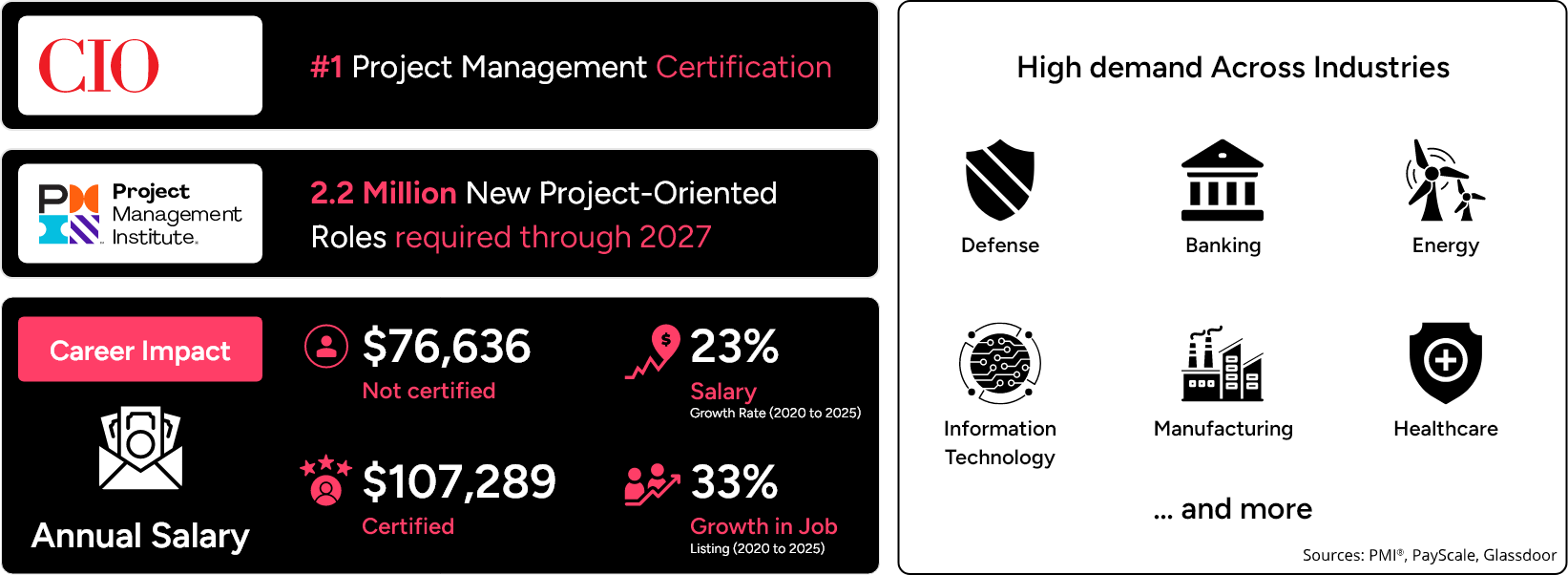
PMP certification can open up many career opportunities in a variety of industries. It helps in Career advancement, higher salary, global recognition, improved skills and increased confidence. It is a valuable investment for professionals who want to advance their careers in project management.
Project Management Professionals (PMPs) are in demand across a wide range of industries. Top Industries Hiring Project Management Professionals in 2023 include:
- Construction
- Engineering
- Information
- Technology (IT)
- Finance, Insurance Services
- Healthcare
- Marketing
- Manufacturing
- Law
- Consulting
- Energy and Utility Services Industry
The average salary for Project Management Professionals (PMPs) can vary widely depending on factors such as location, industry, level of experience, and job responsibilities.
However, according to the Project Management Institute’s (PMI) Earning Power Salary Survey, MP certification holders earn a median salary that is 25% more than those without the PMP certification. The average median salary of a project manager is $116,000.
You can pursue other project management certificates like the PRINCE2 or Agile credentials and become a more effective project manager after attaining the PMP certification.
To maintain your PMP certification, you must earn 60 Professional Development Units (PDUs) every three years. You can earn PDUs by participating in professional development activities such as attending conferences, completing courses, and volunteering.
- PMP Workshop Experience
At upGrad, the PMP Training is offered as a blended training program which consists of both live instructor-led training and self-paced learning sessions.
At upGrad, our instructors are knowledgeable, engaging, supportive, and passionate about project management. They have extensive experience in project management, have hands-on experience managing projects and share their practical knowledge and insights with students.
The software and system requirements for PMP certification training are relatively minimal. You will need access to a reliable internet connection, a computer or laptop, a web browser and MS Word or similar application.
A link will be sent to you on your email. You can click on it and enter the class.
If by any chance you happen to miss the class, we provide you with a recording of the missed session, and offer you an opportunity to attend a makeup session.
Additionally, each class starts with a summary of what was covered in the previous session.
There is no limit on the number of quizzes that you can undertake. However, you will have limited attempts for the assessments.
Our support team offers round the clock availability, ensuring assistance is available anytime.
- Finance-Related Queries
Our courses are designed to equip you with some of the most relevant and sought after skills required to effectively plan and manage projects. However, if your expectations are not met, we offer a refund in accordance with our 100% money
We request candidates to keep us informed at least 24 hours in advance. We check availability in the next batch, and provide you with the most accurate and up-to-date information on how to proceed.
Yes, there is a 100% money-back guarantee for this course.
Yes, scholarships are available to students and veterans for up to 50% of the course fee. Reach out to our support team for more details.
If you are a group of 3 and above, we offer up to 30% discount. The discount depends on the number of participants.
—
Yes, we do have the provision for payment in instalments. Reach out to our support team for more details.